Minigraf: The SQLite of bi-temporal graph databases
A self-contained graph database with time-travel capability, enabling developers to store, query, and audit connected data with full history preservation.
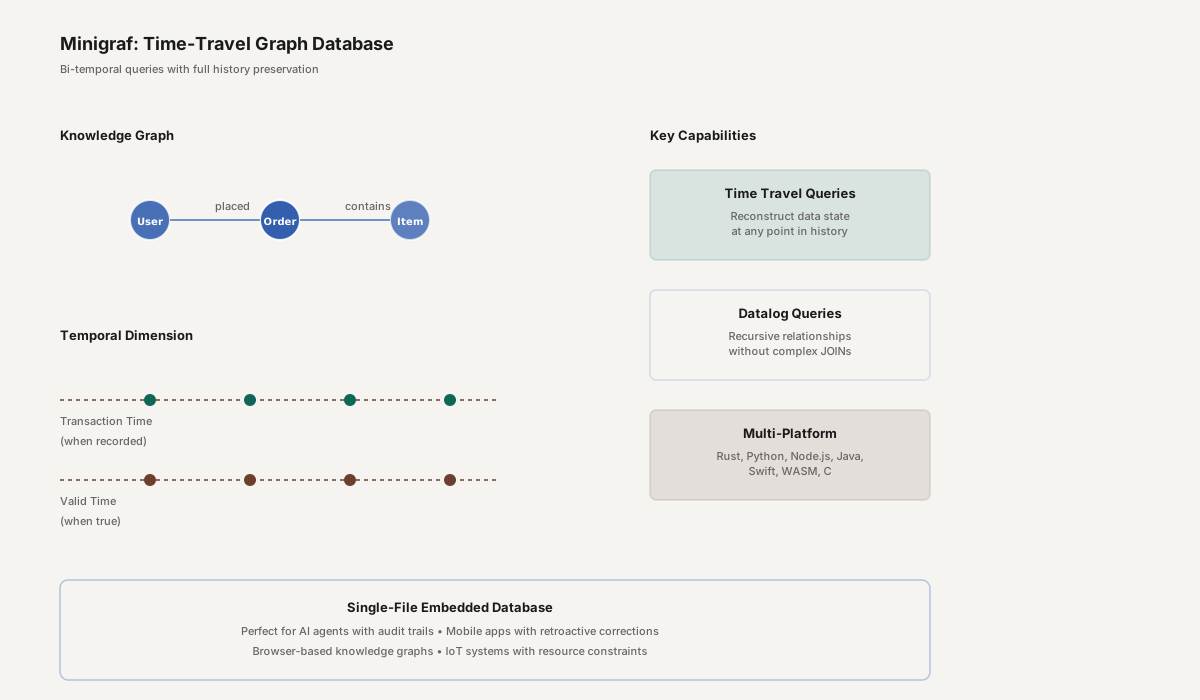
- Minigraf is a zero-configuration, single-file embedded graph database using Datalog queries.
- Bi-temporal time-travel tracks both when facts are recorded and when they're actually true.
- Multi-platform bindings for Rust, Python, Node.js, Java, Swift, WebAssembly, and C enable use anywhere.
Minigraf positions itself as "the SQLite of bi-temporal graph databases"—a self-contained, single-file embedded database that requires zero configuration. Unlike traditional databases, Minigraf preserves complete history: it tracks both when facts are recorded (transaction time) and when they're actually true (valid time), enabling developers to time-travel through data and reconstruct the state at any point in the past.
Why bi-temporal graphs matter
Most developers encounter two problems when building intelligent systems: first, storing connected data (relationships, dependencies, beliefs) efficiently; second, auditing decisions by replaying what the system knew at any given moment. Minigraf solves both. By combining graph queries (via Datalog) with full temporal history, it's particularly valuable for AI agents that must justify their reasoning, mobile apps that work offline and later sync retroactively, and systems where data corrections need to flow backward through time.
Core capabilities
Datalog query language. Instead of SQL's JOIN syntax, Minigraf uses Datalog—a recursive query language that mirrors how developers think about relationships. A single rule can express complex patterns without nested queries.
Window functions. Aggregations like sum, count, and rank work over partitioned datasets, enabling analytics over time-sliced data.
Prepared statements. Parse once, execute many times—critical for performance-sensitive applications.
Multi-platform bindings. Native support for Rust, Python, Node.js, Java, Swift/iOS, WebAssembly, and C means developers can use Minigraf wherever their code runs.
Offline-first. A single file on disk, no server required. Perfect for mobile and browser applications that need local query capability.
Real-world applications
AI agents with audit trails. When an agent makes a decision, storing its belief state (what facts did it know? what was uncertain?) in Minigraf lets you replay that decision later, validate it against new evidence, and explain it to stakeholders.
Mobile apps with eventual consistency. Record changes locally with timestamps, sync later, and Minigraf automatically reconciles retroactive corrections. Users see consistent data offline and on.
Browser-based knowledge graphs. WebAssembly bindings mean your frontend can query and visualize a knowledge graph entirely in-browser—no server round-trips for basic navigation.
IoT and embedded systems. Constrained memory and CPU are no blocker; Minigraf's single-file design and efficient Datalog execution fit resource-limited environments.
Why it matters
The explosion of AI agents, offline-capable apps, and systems requiring audit trails has exposed a gap: developers need graph storage with history. Building this from scratch means writing custom temporal logic, handling retroactive updates, and managing the complexity of time-aware queries. Minigraf eliminates that burden. By making bi-temporal graph storage as simple as SQLite made relational storage, it democratizes building systems that can reason about their own knowledge and justify their decisions—a critical foundation for trustworthy AI systems and collaborative applications.
Minigraf is open source and available on GitHub and PyPI. Bindings for your favorite language are likely already available.
The Appboxs newsroom covers launches, funding, acquisitions, pricing changes and AI across the SaaS and no-code world. Every story links to its primary sources. Have a tip, a correction or a story we should cover? Send it through our contact page.